Saturday, 7 January 2017

A new year, a new continent

South America at last! When we set out on our trip last April we thought we would be in Mexico for about two months at the most and in Central America for two months at the most. What we didn't know was that all these countries had so many wonderful places of interest, beautiful scenery and amazing wildlife to offer, not to mention the friendly, welcoming people. So, there was every reason to take our time and not just keep on driving through.

With Lucy safely tucked up in her container, we flew from Panama City to Cartagena on the Caribbean coast on Friday 23rd December. Now, Cartagena is apparently Columbia's number one tourist destination and we'd had some trouble finding ourselves somewhere to stay, it being the busy Christmas period. Eventually, we had booked what was described as a small internal room without a window so Sue had visions of us living in a broom cupboard for the duration of the festive period.

In the event, Casa Alejandria turned out to be a really sweet little hotel right in the centre of the old city with lovely, helpful staff and our room, whilst it did not have a window, had everything else we could have wished for. It was not at all small compared to some rooms we have occupied, it had its own fridge to store our wine and beer and it had a very nice bathroom with probably the nicest hot shower we have experienced on our travels. Sue tends to rate our accommodation according to the quality of the shower and we've seen them all: functional, non-functional, cold, hot, intermittent, dribbling, flooding, occupied by spiders and cockroaches and accessed by muddy jungle tracks but this one was perfect!

Our bedroom door opened out onto the most delightful little courtyard where we could sit and enjoy our evening bottle of wine whilst putting the remainder of the world's problems to rights, as is our wont. The courtyard was for general use but we mostly had it entirely to ourselves.

Christmas day was a quiet affair as they say in Lake Woebegone. We started by opening our presents, very thoughtfully sent by Sally, which included a remarkable tee shirt with a dirty Land Rover on the back for Alan, some posh chocolates for Sue, some Yorkshire tea and of box of Christmas crackers. We then managed to Skype all the children and even managed to talk fleetingly with all the grandchildren and whilst we couldn't smell the Christmas turkey we felt the Christmas cheer and were happy.

After that we went out into town, strolled around, took some photographs, had lunch at a Cuban café, strolled around some more and then in the evening we went to the Montmartre restaurant and had an exceedingly nice supper.

Street in the old quarter, Cartagena

Street scene, Cartagena

Fruit sellers, Cartagena

Colonial buildings in old quarter

Balconied houses in old quarter

Typical ornate door knocker

We were surprised that Christmas day in Cartagena seemed very much like any other day, at least two thirds of the shops were open and the streets were full of people milling around. Then in the evening the restaurants were packed, families gathered in the squares and little children raced around with their new Christmas toys and it felt very festive.

Christmas in Cartagena
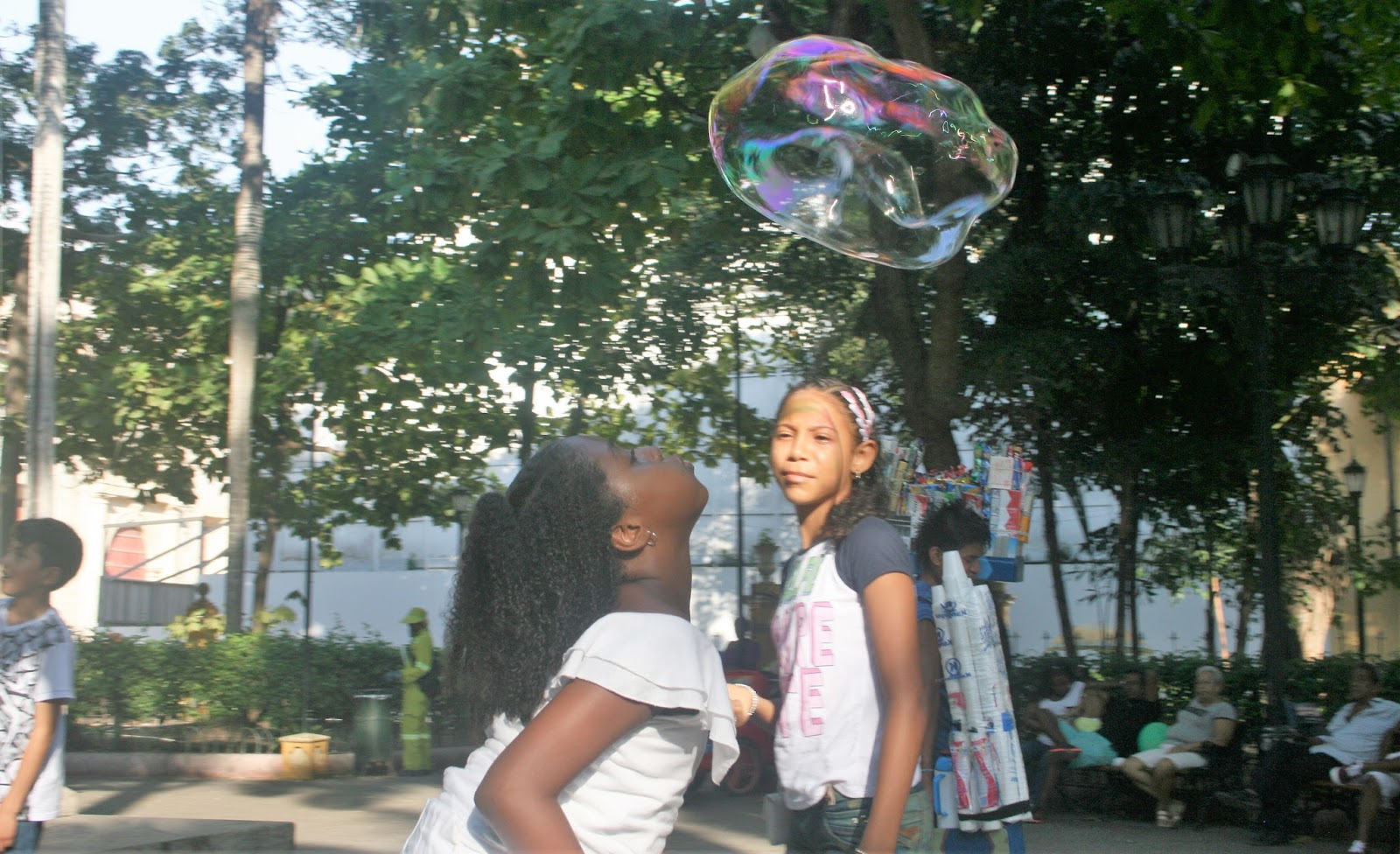
Chasing bubbles

Boxing day was spent walking the city walls (built after a particularly costly attack by, you've guessed it, Francis Drake) and meandering around the maze of cobbled streets with their fine colonial buildings and vibrant bougainvillea draped over archways and balconies. We can understand why this city is such a magnet for tourists, it is quite beautiful.

That's not a gun, this is a gun
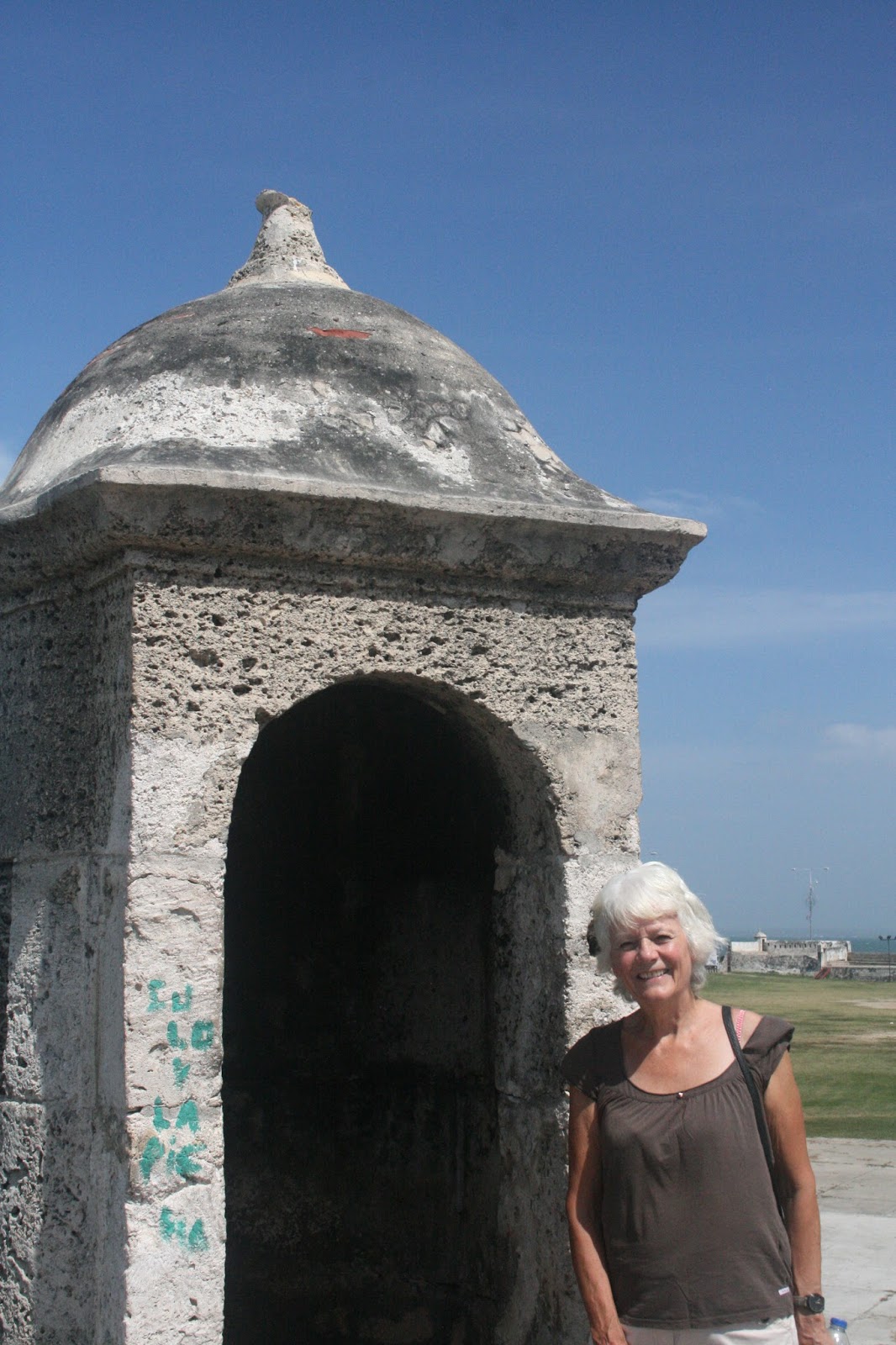
Sue on the city walls

Lucy's ship arrived in port on Boxing day and early on Tuesday 27th December Alan went off to the port authority to start the tortuous process for getting her released from the clutches of the Columbian customs officials. It took two full days of playing round and round the rugged rocks with various forms, officials, sub-officials, minor functionaries and receptionists.

Alan lost track of all the various steps that he had to go through but it involved passport, driving licence, bills of lading (temporary and final), permissions to export vehicles from Panama and permissions to import vehicles to Colombia and a variety of other forms which seemed to be largely designed for the confusion of people who don't speak Spanish.

All the forms required photocopies, five of this one, three of that one, two of the other one. To get the photocopies entailed walking about two kilometres to the photocopying place and back, this in addition to the various route marches between the customs and other offices, all in the searing heat. The photocopies had to be checked and then stamped by someone else and then signed and then taken to another office to be checked again and then taken to the bank to pay the fees. Every so often someone would go off for a siesta or for lunch during which time absolutely nothing whatsoever happened.

Just before five o'clock on day one the Senora at customs pronounced herself to be completely satisfied with all the paperwork and the five gringos who were involved in trying to get their vehicles out then did an impromptu rain dance in the middle of the reception area, much to the amusement of the Colombians.

Alan returned to the port authority for 8.30 am on Wednesday where more officials pushed more bits of paper around, then he was allowed to back Lucy out of the container and then there were more siestas and lunch breaks. So the five gringos all stood around for a bit longer and then came the vehicle inspection which comprised a man looking at the chassis number engraved on the inside of the windscreen. Some inspection!

Lucy waiting to be free

Eventually at about 3 pm, after a great deal of sweat and shoe leather, Lucy was released  and all was well.

We bid a fond farewell to Cartagena on Friday 30th December and made our way north eastwards to the village of Minca on the slopes of the Sierra Nevada de Santa Marta, renowned for being a birdwatchers paradise.

Minca is surrounded by beautiful forest clad hills and all the buildings in the town cling to the sides of the precipitous slopes and there is virtually nowhere flat. We tried two or three different places that apparently had camping but we couldn't fit Lucy into the space available so we ended up at a small hotel about a kilometre north of the village.

We managed to arrange an early morning walk and were up at five o'clock on New Year's Eve morning to meet our guide at six o'clock. However, he was on Columbian time and turned up at six thirty but all was forgiven because we had the most wonderful morning. To be up in the early morning was a pretty magical thing. The sunlight touched the tops of the trees and then crept up the side of the hill, warming and waking everything as it went.

Dawn, Minca

Guard dog, Minca

The place was phenomenally good for birds and we both agreed we had never seen so many different species in such a small area. Among those that we can remember were toucans, toucanets, araucaris, oropendolas, a tree creeper, humming birds, a squirrel cuckoo, a broad billed anis, motmots, tanagers and oriels. One of the hummingbirds we saw was busy building a nest the size of half a walnut out of spiders web and lichen. There was also a very large unidentified eagle which we briefly saw and which must have had a wingspan of seven or eight feet.

Blue crowned motmot, Minca

Unidentified bird, Minca

Hummingbird building its nest, Minca

Hummingbird on nest, Minca

Waterfall, Rio Minca

Grumpy old man, Rio Minca

Having got up so early in the morning we didn't actually manage to stay awake long enough to see the New Year in although we enjoyed a few glasses of wine and exchanged 'Feliz Ano Nuevo' greetings with the happy, noisy crowd of Colombians around us.

We set off on New Year's day in a southerly direction and had an entirely uneventful day's driving on mostly straight, well tarmacked road, then stopped off for the night at a place so forgettable that neither of us can remember its name.

Next day the drive was much more interesting. We soon turned off the tarmac road and then we took the golden road to Santa Cruz de Mompox. Alan named it the golden road because firstly it was a yellow, dusty, dirt road but also because it was lined with the most glorious golden yellow and occasionally mauve trees which were in full bloom.

On the golden road

Further along the golden road

The road itself was quite interesting, there were a couple of potholes that were designed to send the shock absorbers through the bonnet and then after crossing the Rio Magdalena on a ferry (for which the ferryman tried to charge us five times the going rate) we arrived at the town of Santa Cruz de Mompox. Its name sounds like a rather unpleasant tropical disease but it isn't, it's a very attractive colonial town situated on the banks of the river.

Ferry crossing on the Rio Magdalena

The town used to be quite an important port for the distribution of goods to the interior of this part of Colombia but apparently the Rio Magdalena silted up and now no large vessels can get here. What remains are its very attractive colonial houses and churches, many of the houses with internal courtyards and featuring absolutely massive timber doors some twelve feet high.

'Walt Disney' church, Mompox

Steptoe without son, on the Malecon at Mompox
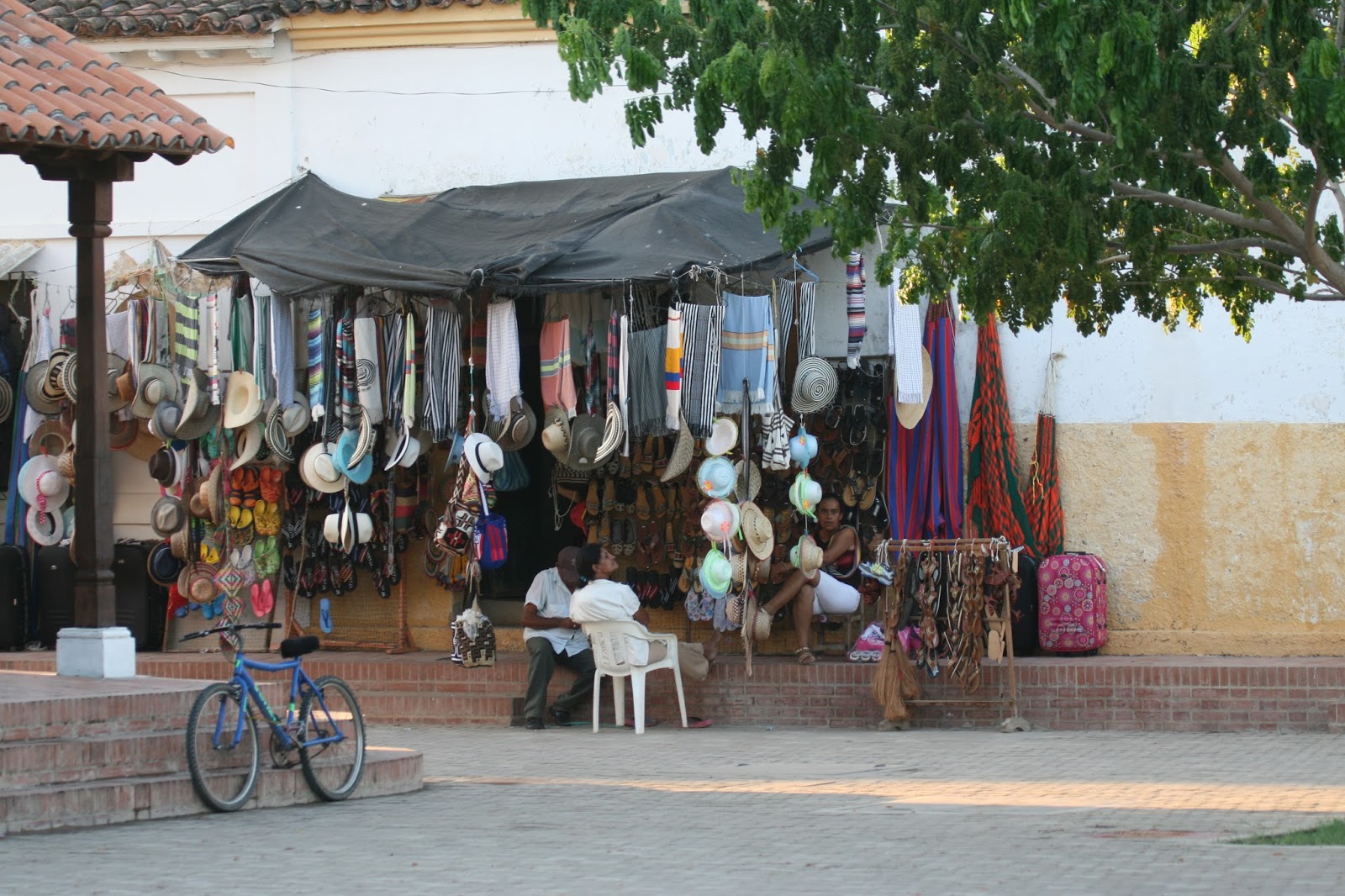
Market stall, Mompox

Girl in a window, Mompox

We spent a very pleasant couple of days pottering around the town and along the river front and, of course, we had a boat trip. We managed to organise a boat and a boatman all to ourselves and enjoyed a four hour trip which took us down river and then into one of the backwaters built by the original indigenous tribes of the area. From here we snaked through ever narrower channels into the wetlands where we saw an abundance of birdlife. Whilst we were able to identify many of the birds ourselves, unfortunately our boatman, whilst being able to navigate his way perfectly through the myriad of channels, did not have a clue about birds so we could not be sure what they all were.

Iguana, Rio Magdalena

Probably a caracara, Rio Magdalena

Male ringed kingfisher, Rio Magdalena

Female ringed kingfisher

Fisherman, Rio Magdalena backwaters

Kingfisher on a mission

Communal bath time, Rio Magdalena backwaters

Fisherman with casting net

Probably a limpkin, Rio Magdalena backwaters

Groove billed anis

Flowering water plants, Rio Magdalena backwaters

Fishermen in dugout canoe

Black vultures on floating corpse

View of Mompox from Rio Magdalena

Mompox from Rio Magdalena

Although we planned to leave on Thursday our departure was delayed by a day due to Sue having a small dose of Montezuma's revenge. Luckily, she was in good order by yesterday morning, Friday 6th January, and so we were able to get on the road again.

Our journey south was pleasant enough. To begin with we were driving through wetlands and large expanses of water on an elevated roadway and there were lots of interesting birds, including ibis and snail kites. The morning was also enlightened by what we think is probably the most unusual 'freight' we have ever seen on a motorbike. What we saw was a 100cc motorbike with a man on the front and a woman on the back, nothing unusual there you might say. However, between them were two pigs and we are not talking small weaners, we are talking full scale bacon size grunters. They were trussed up with a piece of rope around their mouths to prevent them from biting anyone and one was stacked neatly on top of the other between the driver and the passenger.

After a forgettable lunch at a forgettable restaurant in a forgettable town we continued on our merry way with the road climbing up and up. Eventually, we came to a big traffic queue in a small town and then came to a complete halt. We soon found out why. A carnival came along with a float resembling something a bit like a large floppy puppy followed by lots and lots of dancers, male and female, all dolled up to the nines and most of them carrying bags of flour which they threw at people, including us. We captured both the carnival and the pig freight beautifully on camera but Alan inadvertently managed to wipe the photos before we could download them so you will just have to take our word for it.

Ultimately, we got through all the festivities and after seven hours of driving arrived at the city of Bucaramanga where we are now staying. Today is a rest and recuperation day and Lucy has had a bit of attention getting her wheels balanced and the large splatterings of flour from yesterday washed off.

All being well, we shall be on the road again tomorrow, Sunday 8th January, to the mountainous area of Santander and the white waters of the Rio Fonce.

Thursday, 22 December 2016

Panama - it's not just about the canal

You'd think that we'd have got the hang of border crossings by now, considering how many we have passed through, but it doesn't seem to get any easier. We reached the Costa Rica/Panama border in good time on Thursday morning (8th December) and unsurprisingly there were no directions or signs and there were the usual hoards of people milling around everywhere. We picked up a helpful 'fixer' who earned himself a few dollars by steering us around the various officials but it didn't seem to speed our passage much, it was two hours five minutes this time to get through.

After a late lunch we headed east along the Pan American highway for a while and then turned off south to a small fishing village called Boca Chica where we stayed for a couple of nights.
The village suited us very well. It was a bit shabby but not sleazy, scruffy but not dirty and little children ran freely in and out of the banana plantations.

Health and safety Panama style

Supper on Thursday evening was at the establishment of Senora Wimpey. Alan called her that in homage to the character in Popeye movies who was somewhat generously built in the rear section. Her establishment was very relaxed, consisting of a corrugated iron roof, a concrete floor and a number of white plastic tables and chairs. Amongst these, in no particular order, roamed children, chicken and dogs although only the latter seemed to be interested in our food. Supper however was a triumph, it was a fish called corvina and it tasted wonderful.

Fishing boat setting out to sea at Boca Chica

On Friday morning we pottered down to the boat dock past all the fishing nets drying in the sun and asked around until we found somebody who was prepared to take us out to the islands, of which there are apparently more than a hundred. Our boatman took as around various islands for a while and then we were dropped off at a little uninhabited island with a palm fringed, pure white sandy 'Bounty bar' beach on both sides with just a very small ridge of rock between the two sides.

Our personal treasure island

Sue pretending to be Ursula Andress

After an hour or so of gentle snorkelling we picked up the boat again and were taken to another larger island where there was a restaurant which had both beer and prawns. The whole trip (about four hours) was immensely enjoyable and after we got back we both agreed that the little 'treasure island' that our boatman took us to must rank among one of the most wonderful places we have ever visited.

Lunch stop

Bounty bar country

Blue footed booby landing on our boat

On Saturday morning we set off on the road again heading east through Panama with the hope that we might get to the Darien eventually. The Darien is an area, about 200 kilometres long, of thick jungle which stretches between Panama and Columbia and is inhabited primarily by indigenous Indian communities. One of the main attractions, particularly for Alan, was the possibility of seeing one or more Harpy eagles which inhabit the area.

After stopping off at a rather seedy town on the Pan American Highway for lunch and to pick up provisions we discovered that our fridge was no longer working. Alan lifted the bonnet and started rummaging around and scratching his head and before too long a chap came along and he also started rummaging around under the bonnet. Ultimately it was agreed that what we probably needed was a new domestic battery and, like so many other kind people that we have met on our trip, the chap then went out of his way to take us to a 'Casa de Baterias'. Wonder of wonders, the battery specialist stocked the correct Optima battery and, after checking that ours was completely dead, a new one was duly fitted and the fridge started buzzing nicely again.

On Sunday we had another long drive along the Pan American highway which included navigating our way through Panama city. Panama City itself was not a delight to drive through, in fact it was b....y awful. Matron, the verbal manifestation of MapsMe,  threw up her hands in horror and we navigated by a combination of intuition, the compass and reference to MapsMe without Matron's interference.

We had a bit of trouble finding somewhere to stay on Sunday evening but eventually found a pleasant enough place which was something between a farm and a hotel not far from some attractive lakes.

Farm stay at La Margarita

Our plan to have a day's respite visiting the lakes did not come to fruition. When we got up on Monday morning the light in Lucy's rear door was not working, the invertor was complaining and although the fridge was buzzing it was not cold. To our simple minds this suggested that the means whereby the power is transmitted from the primary battery to the secondary battery had somehow become interrupted. So, we had a day of electro-mechanics instead.

This involved returning to Panama City which did not fill us with joy. First stop was at a 'Casa de Baterias' who said they couldn't help because the problem was not the battery, it was the electrics that were 'mal'. The chap there pointed us in the direction of an auto electrical mechanic and he rummaged around inside the vehicle in the time honoured manner, scratched his nose in a way that has become ominously familiar and then directed us to a different and even more specialised auto electrical engineer.

The second specialist was a fine fella, he rummaged around quite a lot and said he thought he could sort it out. After about an hour and a half he decided that he couldn't fix it but he thought his brother could. Whilst all this had been going on we had got chatting to an exceedingly nice young taxi driver whose name was Gustavo and he then guided us through the heavy Panama traffic to specialist number three. By this time it was about four in the afternoon and specialist number three, Senor Juan, said he could fix it but not today and asked us to return at eight o'clock the following morning.

Faced with the prospect of a four hour drive back to La Margarita where we were staying and a four hour drive in the morning to get to the mecanico by eight in the morning, our only sensible option was to spend the night in Panama city. Gustavo then took us across the city to a perfectly nice hotel which we would never have otherwise found which charged us only thirty dollars a night for a perfectly decent room.

We delivered Lucy to Senor Juan at eight o'clock on Tuesday morning and he had the vehicle until half past three. We filled in the time sitting on a tour bus, complete with commentary in four languages which we neither of us listened to. We did however go and have a look at one of the locks on the canal but there were no ships in it at the time. The canal system runs some 80 kilometres from the Caribbean to the Pacific and consists of lakes and inlets connected together by stretches of canal with locks. We did wonder why there are locks and apparently it is because the lake is significantly higher than sea level on either the Pacific or Caribbean side.

Pacific to the left, Caribbean to the right

The under side of Panama City

Old Panama fish market

Fishing fleet with Panama City skyline behind

When we returned to Senor Juan at half past three he had indeed fixed the electrics but even he wasn't quite sure how he'd managed it. So, we were good to go again!

By mid afternoon on Wednesday 14th December we were in the Darien. Our aim was to get to La Chunga, a village inhabited by the Embera indigenous people, where we had the best chance of being taken to see a Harpy eagle's nest. After driving for about four and a half hours we got to Puerto Quimba where the road finishes beside a river and where there were lots of boats and a lot of army who asked us lots of questions. Having satisfied them that we were not smuggling cocaine we left Lucy in their care and got into a very rickety launch and sped off to the village of La Palma where we stopped for the night.

On the way to La Palma

Riverside property at La Palma

Nobody in La Palma could tell us when or if there would be a boat leaving for La Chunga which is reached by going some way around the Darien coastline and then up the Rio Sambu. So, it was more in hope than expectation that we wandered down to the boat dock on Thursday morning. By a stroke of serendipity a launch was leaving right then and after a two and a half hour boat trip and a forty five minute walk through the swampy, steaming, mosquito infested jungle we arrived at the Embera village of La Chunga.

Fishing boat adorned with pelicans

The pontoon on Rio Sambu

Walking through the swamp to La Chunga

We were immediately greeted by the village 'hospitality officer' and guide who took us to our lodgings with one of the local families. Sue was slightly fazed to begin with as our bedroom was a piece of wooden floor shared with several sacks of rice and the washing, however someone produced a mattress and mozzie net later on so all was well.

The La Chunga Hilton

Honeymoon suite at La Chunga Hilton

The slightly disappointing news was that the Harpy eagles are no longer in this area. We found out later that one of the nesting pair was shot and killed a couple of years ago, apparently by a 'jealous' member of a neighbouring community who resented the little bit of 'tourism' that La Chnuga was getting from the interest in the birds. The surviving eagle had unsurprisingly left the area after its mate was killed.

We spent a wonderful couple of days in the village. The Senora cooked our meals with the food we had brought with us, our guide took us for walks in the jungle, Alan wandered around taking photographs whilst Sue chilled out in a hammock, we bathed in the river and generally soaked up the atmosphere of the village.

Village house, La Chunga

La Chunga village

I'm a celebrity, get me out of here

Bath time in La Chunga river

Curassow, La Chunga

Squirrel monkey, La Chunga

La Chunga river

We really warmed to this small Embera village. There was a pervading air of contentment and happiness, we never heard any signs of discord, the children ran freely and we only heard a child cry once when he banged his head. Their horizons are limited by the river and the jungle of the Darien but it seemed to us that their wealth could be counted by the fewness of their wants.

La Chunga swimming club

A child's life in La Chunga

Children playing in La Chunga

Wash day, La Chunga river
Siesta time

The journey back from La Chunga on Saturday was not without its events. First of all we had to get to the launch pick up point which involved walking at two thirty in the morning with only a half moon along a muddy track and then fording a river (let it be noted that Alan gave Sue a piggy back for this bit). We got to the boardwalk which consisted of a half mile long series of rotting planks with swamp underneath harbouring various unkind creatures upon which one would not wish to land. With the help of our mentor and guide, his wife and three torches we got to the pontoon without mishap.

The first launch that came along was full to overflowing so we let it go and so frankly was the second one but as there were only two we got into the second one. We then had a three and a half to four hour trip which to begin with involved going at fairly high speed with a grossly overloaded boat down a muddy river that was full of fallen trees. Luckily there was a man sitting on the prow with a large flashlight and depending upon the degree of anxiety with which he was flashing it the driver either went to left or to right.

All was well until we got out on the open sea when a fishing net snagged the propeller which took some time to disentangle. Then about a mile from La Palma we ran out of fuel so the driver picked up a very large single bladed paddle and he, Alan and someone else took it in turns to paddle the boat along the shoreline until another launch came along and gave us a tow as far as the gasoline station at La Palma. Having refuelled we finally got back to Puerto Quimba where Lucy had been domiciled for three days and, lo and behold, there she was without a screw missing!

Our little adventure into the Darien was a wonderful experience but Sue, for one, was quite pleased to get back to civilisation and a hot shower! Since we returned to Panama City on Saturday 17th December our time has been devoted to catching up on the usual admin and domestic tasks but, more importantly, working through the complexities of getting Lucy shipped across to Cartagena in Columbia, there being no road through the Darien gap.

The first stage involved taking Lucy to the Vehicle Inspectorate in Panama City early on Monday morning. We had been fortunate in being able to link up with a fellow traveller, a young American called Josh, in Nicaragua and we had agreed to share a 40 foot container, thus reducing our costs. Josh had found a really helpful agent, Boris, who gave us very clear step by step instructions of exactly what we needed to do.

We thought the inspection would be very detailed but, in the event, it only involved them making a note of the chassis number and then telling us to come back after two o'clock to collect a certificate. We went back at about three o'clock and then waited around until about half past four when we got the required certificate saying that the vehicle could be exported.

We all met up with Boris in Colon (the port city at the northern end of the canal) on Tuesday morning and, having produced five photocopies of just about every document and piece of paper in our admin folder, we proceeded to customs. The customs office was in festive mood and most of the personnel were wearing party hats and reindeer horns but it didn't seem to make them any more efficient.

From there we took the trucks, in the company of Boris, to the container port which actually more closely resembled a large scrapyard. The vehicle was reversed onto a low loader and the low loader was then jacked up so that Alan could drive it into the container and then exactly the same procedure happened with Josh's vehicle. They then secured the vehicles with wheel blocks and large nylon straps and then they closed and sealed the container with the customs seal. They wouldn't let Alan put a padlock on the outside due to customs regulations so we hope Lucy will be safe on her journey.

Loading Lucy into the container

Lucy safely tucked up in the container

Our flight to Cartagena leaves early tomorrow morning, Friday 23rd December, and so a new chapter will begin. Our Christmas will be a different one this year and we shall miss spending it with our loved ones but we shall certainly be raising a glass of margarita or two in the warm Columbian sunshine.