Wednesday, 7 September 2016

The Rocky Road to Paradise

Our first couple of days in Guatemala didn't turn out quite as we had anticipated. We left Black Rock on Tuesday 23rd August and got to and then through the Belize/Guatemala border remarkably easily, the whole process taking less than an hour.

We bowled along in good order until an extremely large cloud of what we thought was steam came out of the exhaust pipe obscuring virtually everything behind us. There weren't any other obvious signs and it then seemed to clear itself so we carried on, only for it to happen again. Good sense then prevailed and we returned to the village where we had stopped for lunch and sought out a mecanico. Senor Sanchez seemed to think we needed a new thermostat and told us to bring Lucy back again the following morning.

We took Lucy along to Senor Sanchez Wednesday morning, as arranged, and in order to demonstrate what the problem was Alan took him for a ride, with dramatic effect. Not only was there a small cumulo-nimbus of smoke issuing from the exhaust but enough flames to start a bush fire. Senor Sanchez' opinion changed several times before he finally decided that it was the turbo.

Alan spoke to Graham from AdventureTrex in San Ignacio and he also said it sounded like a turbo problem. He had by a stroke of good fortune a second hand reconditioned turbo in stock which he could sell us and he also offered to take it to the Guatemala/Belize border which was gratefully accepted. So we set off in a taxi to take us the 50 or so miles back to the border where Alan collected the reconditioned turbo from Graham. We then delivered Lucy and the replacement part to Senor Sanchez and he duly fitted it the following morning.

By 11 am on Thursday 25th August we were on the road again and by 2 pm we were at the gates of Tikal National Park. We drove another 20 km or so to the area of the Mayan ruins where we set up camp, just before a tropical storm set in which lasted well into the evening.

Campsite at Tikal

We were up early on Friday morning to visit the ruins. Tikal is a massive site, much bigger and more jungly than any we have visited before. The restored temples are very impressive and there are hundreds more that are not yet restored. The area is so vast and there are such long walkways between the various features that it took us over three and a half hours to go round and we didn't see half of it. When we climbed the highest temple we got a sort of a descending aircraft view of the site with all the jungle and the other buildings popping up through the canopy.

Temple ruin at Tikal

Detail of temple ruin

The view from Temple IV

Temple ruin at Tikal

Parasitic plant at Tikal ruins

The other distinguishing feature was the abundance of wildlife. In the campsite area there were families of oscillated turkeys wandering around, aracari toucans, coatamundi which look a little like a cross between a rat and a fox with a ringed tail that sticks straight up in the air and a coati which looks like an overgrown guinea pig. In the ruins we saw more toucans and spider monkeys doing their acrobatics in the trees and then our attention was drawn to a large tarantula which was trying to enjoy a rest within the root system of a large tree until Alan started poking it.

Oscillated turkey looking surprised

Roadside hawk (we think)

Probably a coati

Alan tickling a sleepy tarantula

On Saturday we set off from Tikal in good order for Flores, some 60 km away. Flores is a picturesque town which is essentially a little island at the far western end of Lago Peten Itza, accessed via a causeway. There we checked in at a small hotel bang on the road which goes around the perimeter of the island. We had a wonderful view from our little balcony to the west across the lake, a very good place to drink a glass of wine and put the world to rights.

Sunset at Flores island

On Sunday morning we wandered around the town and savoured its delights including following the town band complete with double life size puppet with its flailing arms and various oompah instruments.

Marching with the band at Flores


Narrow alleyway in Flores

After lunch we went to climb the 'mirador' or viewing platform on the opposite side of the lake. This involved taking a 'lancha' or water taxi across to the mainland and walking up an extremely steep and very hot road and then mercifully the rest of the way through the dappled shade of the forest until we reached the lookout.

View of Lago Peten Itza from viewing platform

The island of Flores - view from lookout

Flores was a pleasant respite and we left there on Monday morning secure in the knowledge that we had a new turbo unit and all was now well with Footloose Lucy. Wrong!

After about 50 km we were proved incorrect in our assumption because once again we had a cloud of white smoke and flames coming out of the tail pipe. After some deliberation we returned to Santa Elena, the town next to Flores, to find another mecanico. On Graham's advice the mecanico cleaned the oil filter to the side of the rocker cover although he said he thought it was a waste of time. We then got on our way again and continued southwards in a fairly staccato fashion for many miles until we thankfully got to a quite delightful camping area near a place called Poptun where we stopped for the night.

Campsite near Poptun

With some considerable trepidation we set off on Tuesday morning to drive 100 km or so south to Lago Izabel because Lucy had been billowing smoke at regular intervals for the whole of the previous day. In the event we got to Rio Dulce (sweet river) with absolutely no recurrence whatsoever and stopped for lunch at Bruno's bar.
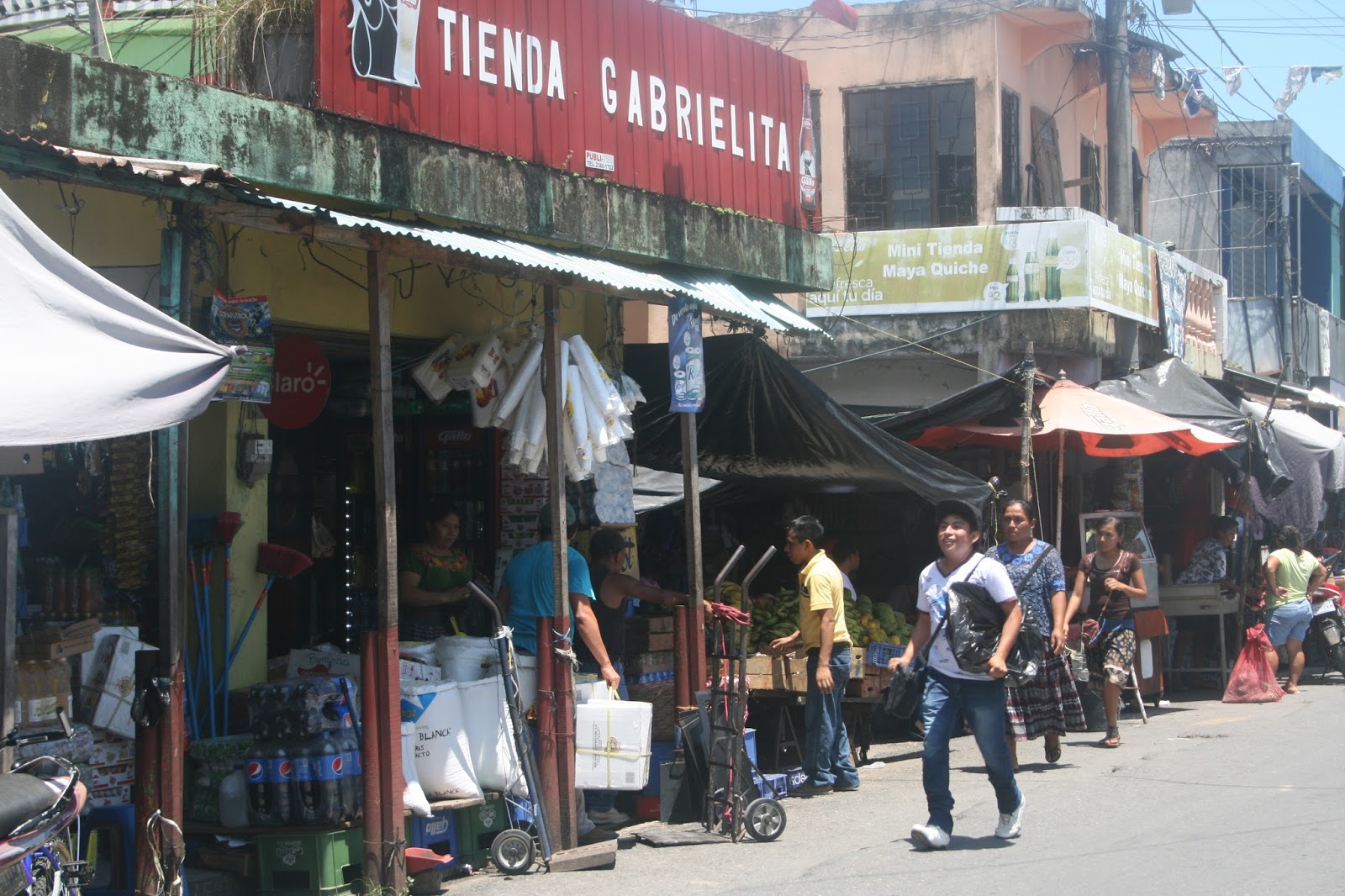
Street scene at Rio Dulce

At Rio Dulce

There we met an American chap called Philipe and his family and he told us about a quieter spot further round to the north of the lake where the road was much more scenic and rural and that we would find some hot springs there. He also told us about his own little jungle resort by the river at Las Conchas about 50 km north of the lake.

Because of Lucy's problems we had been keeping to the main road but, heartened by the fact that we had had trouble free motoring so far that day, we decided to follow Philipe's recommendation. We set off from Rio Dulce which was very hot and noisy and followed the lakeside road until we arrived at a place optimistically called El Paraiso which was a little resort fronting the lake. It was a lovely spot but the weather set in and the far shore of the lake was lost in the mist.

Next morning we visited the hot springs that Philipe had told us about. Strictly speaking they were not hot springs, it was a normal bubbling mountain river which came bouncing through a load of rocks until it landed in a pool. Above the pool was a hot stream which came in by means of a waterfall about 35 ft high. This waterfall was boiling hot, in fact so hot you couldn't really stay under it for very long otherwise you got scalded. The combination of the cold river water and the hot waterfall made the pool beautifully warm.

Hot spring near Lago Izabel

Alan enjoying a hot bath

Leaving the hot springs we then drove the very short distance to Philipe's place next to the river. It was a small farmstead with a sort of eco lodge which was about as basic as it gets but rather charming.

Philipe's Janpanese wife cooked us a very nice vegetarian supper and then we sat chatting with them afterwards around a campfire which Philipe had lit although it seemed slightly unnecessary as it was still in the low thirties.

A couple of little incidents convinced Sue that the place was rather closer to nature than she was really comfortable with. A large black scorpion ran out from under a stone surrounding the fire, possibly to escape the heat, and up the side of a wooden chair. Alan's search for it resulted in it finding him first and stinging him on the finger which made him yelp a bit. It hurt for rather a long time but otherwise no ill effects. Apparently it is the little brown scorpions which are the nastiest.
Then there was the eco toilet which was a dry system and which Sue discovered was already occupied by a large spider when she went to use it. To cap it all a small snake slithered across the path about a foot in front of her the following morning (Thursday). She decided it was time to leave!

We drove the short distance to Las Conchas where there were some impressive waterfalls and then got on our way to Semuc Champey which has been described as one of the most beautiful places in Guatemala though difficult to reach.

Waterfalls at Las Conchas

Getting there was an adventure, not to say a bit of a trial! The scenery was absolutely stunning, narrow steep sided valleys covered in greenery, little stubby tree clad hills, steep gradients and a very rocky road to cope with.

Traditional women on the mountain road

View from the mountain road

View from the mountain road

The major problem we had however was a minor collision on a corner on one of the steep sections of road.  A 'collectivo' (large minibus) came up the hill and round the bend on our side of the road and as we were going down hill it was simply not possible to stop Lucy in time. There was no damage to our vehicle but the collectivo suffered a broken snorkel, side light and some distortion to the driver's door. The vehicle was full of young men and they all piled out. There was a discussion, the essence being that insurance doesn't count in Guatemala and that what we had to do was pay the driver lots of money. It was not particularly rancorous but Alan thought that it was going to become so and we were heavily outnumbered. Another vehicle had arrived behind the collectivo and Alan took the opportunity to get out of the situation by squeezing past the very narrow gap and we continued along the road to the small town of Lanquin.

The driver of the collectivo had phoned the police and the police stopped us in Lanquin. Subsequently the driver turned up but as it was now under what one might call controlled conditions we were less concerned. Having produced all the necessary documentation (which the police then kept) we all trooped off to the police station. With the assistance of a translator, who happened to be one of the young men on the minibus, we were given to understand that we had two options. The first was that our vehicle and the collectivo would be impounded by the police and we would appear in front of a judge at some unspecified time in the future.  The second option was that the driver had to be paid something.

So, it all came down to a traditional haggle in the end which Alan always enjoys and we paid the driver 1,300 quetzels which is £130 and we continued along the rocky road to Semuc Champey where we arrived just before nightfall.

Friday was a much better day! We drove the short distance from our lodge to the national park and discovered for ourselves why Semuc Champey is one of the wonders of Guatemala.

The great attraction is a natural phenomenon which is without precendence in our experience. The mighty river goes through a very steep gorge and then charges down underground beneath a 300 metre long 'platform'. It continues in the bed of the gorge underneath this platform and then issues with slightly less violence at the bottom.

River Cahabon disappearing under the pools

As this is a limestone area and because there are many little rivulets and streams coming down from the sides of the gorge the platform has formed itself into a series of 6 or 7 pools. These pools are up to 150 metres wide and are a brilliant turquoise colour. The water is crystal clear, cool and in some places quite deep and it runs from one pool down to the next in a series of little waterfalls and channels. The sides of the gorge which are near vertical are clad in bright blue flowers a little like periwinkle. Add to this the jungle setting and the fact that from time to time huge butterflies go flittering through the dappled light and you have a truly magical place.

The pools at Semuc Champey

A side pool at Semuc Champey

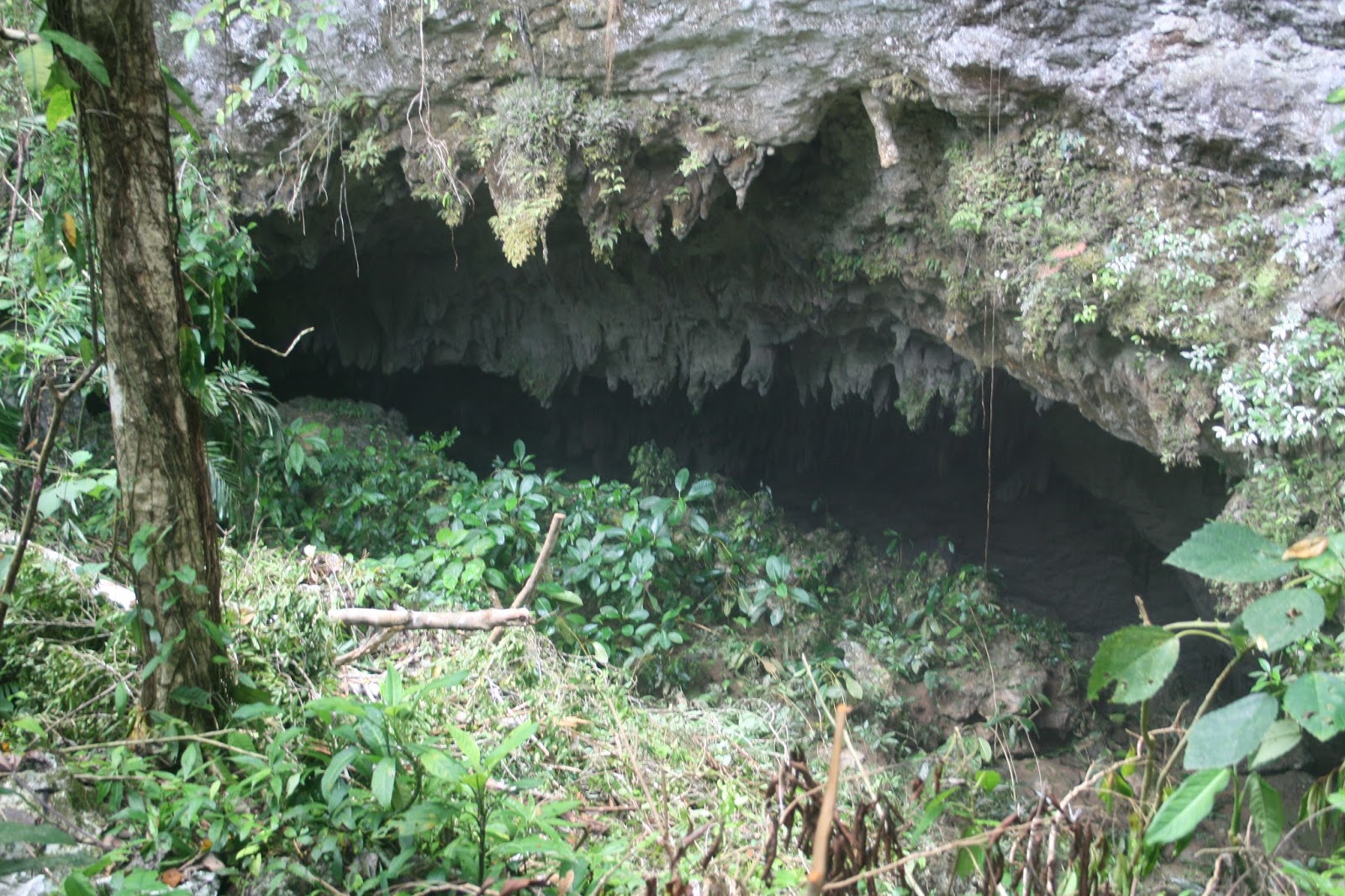
Later in the day we went to vist the local caves. These are very deep, unlit and in many parts unexplored but we went specifically to see the bats. We'd been told that at twilight bats issue from the mouth of the cave so we set ourselves up inside the mouth whilst we were entertained by a tropical thunderstorm with attendant lightning which illuminated the river crashing out of the cave system below us.

View from the mouth of the bat cave

As twilight fell a few bats came out of the cave and before long there were hundreds of them, all swirling and weaving around very close to us but they never touched us. It was very ethereal.

We left this little corner of paradise on Saturday morning to drive back along the rocky road and then on to the town of Coban. The journey was uneventful other than Lucy having more episodes of tummy trouble resulting in large emissions from her rear end.

Looking down on the clouds again

Market scene at Coban

Market scene at Coban

After overnighting in Coban we set off on Sunday morning to drive the 200 km distance to Guatemala City. It was not an easy journey. The now very familiar clouds of white smoke were coming so frequently that were having to stop every 10 minutes or so but we kept going and arrived with a huge sigh of relief in the middle of the afternoon.

Guatemala City was not on our list of places to visit but our reason for coming here is twofold. One is to get Lucy fixed by someone who knows what they are doing and secondly we have a flight booked from here to UK for a couple of weeks in order for Alan to celebrate his 'special' birthday with family and friends.

Today is Tuesday 6th September. Alan has delivered Lucy to a Land Rover specialist, recommended to us by Graham, who will fix her (we hope!) whilst we are away. We fly back to UK via Houston tomorrow and all is well. Blog to be continued after we return here on 20 September.

Tuesday, 23 August 2016

Only toucan play

The keel billed toucan is the national bird of Belize but it eluded us for quite a while

We got to Orange Walk Town in the early afternoon on Thursday 11th August and then made our way down to a restaurant on the bank of the New River. It had extensive grounds and facilities for camping and we parked up under one of the palm trees about 6 feet from the river. It was the most beautiful spot, right on the banks of a slow moving river with lotus lilies and water hyacinths and we sat and watched egrets and lily trotters trotting from lily pad to lily pad whilst sipping cool margaritas.

Campsite by the New River, Orange Walk

Lily Trotter

But, oh the bugs! The place was teeming with mosquitoes. So, our evening was slightly spoilt by the fact that every second or so one or other of us was slapping ourselves in an attempt to kill the little buggers.

On Friday we went to the Lamanai ruins which were all that Mayan ruins are supposed to be tucked away in thick jungle on the banks of the Lamanai lagoon. The two hour boat trip there was fascinating, up through a myriad of twisting channels, some of which were not the obvious course of the river. We stopped a couple of times, once to get a closer look at a spider monkey and the second time to try to catch a glimpse of a manatee but sadly we only managed to see its trail of bubbles.

Spider monkey on bank of New River

Mayan temple at Lamanai

Mayan temple at Lamanai

Close up of temple carving

We returned to a cool evening with a blessed breeze blowing off the river. We had a lovely sausage supper washed down with a bottle of Reservado and surrounded by mosquito coils like a defensive army. We sat happily in more or less mosquito free conditions and put the world to rights as is our custom.

Orange Walk Town didn't have anything much else of interest so we left there on Saturday morning and made our way south to the Crooked Tree Wildlife sanctuary.

Crooked Tree is reported to be somewhat of a birdwatchers paradise, but sadly the area was badly hit by Hurricane Earl, the water level in the lagoon was very high and so we arrived to news that many of the birds had fled. The jabiru storks (the largest flying bird in the Americas) which we were so keen to see, had apparently been there in abundance until the hurricane but were conspicuous by their absence during our stay.

Nevertheless, we enjoyed a couple of really good days there and, with the help of an experienced guide we had some good views of wildlife in the area. An evening trek in the pine forest produced good viewings of beautiful Yucatan Jays, a nesting hole full of a family of acorn woodpeckers and a small and rather worried looking tree porcupine that was sitting up in the tree wiffling its nose at us in a slightly quizzical manner. An early morning boat ride in the lagoon and creek produced good sightings of black collared hawks, a number of kingfishers of different species, a variety of herons, green and black iguanas, and a couple of extremely large crocodiles.

Fisherman with catch, Crooked Tree

Black collared hawk

Black collared hawk

Large iguana

We also paid a visit to Belize Zoo which mainly provides homes for native species that have been injured, orphaned or bred in captivity. Although it was sad to see big beasties incarcerated there was a good educational message for children about the importance of caring for and preserving the indigenous wildlife.

On Monday 15th August we moved on to Belmopan, the Capital of Belize although you would hardly think so. The government decided to move the capital after Belize city was flattened by a hurricane in 1961. The new capital of Belmopan was created in 1971 and it is a totally unremarkable place with a number of government and ambassadorial buildings scattered somewhat randomly within a ring road. It is apparently the smallest capital city in the world and we can believe it.

On Tuesday morning we drove south along the Hummingbird Highway (one of only half a dozen major roads in Belize) which is probably the most scenic route we have travelled here, being the nearest thing to a mountain road through the jungle whilst most of the country is flat.

Our first stop was St Herman's Cave where we did some cave tubing. This involved walking for a short while through the bush, then descending into a cave until we reached a subterranean river and then jumping inside a lorry inner tube and floating gently along the river as it wound its way through the darkness of the cave.

Entrance to St Herman's Cave

On the way to the cave we came across the sloughed skin of a Fer de Lance snake and we hoped that its previous owner wasn't nearby because they are very venomous and rather aggressive.

The tubing trip which lasted a couple of hours was great fun. There were lots of bats roosting in the caves and an amazing collection of beautiful stalactites and stalagmites and columns where the two had met. We turned our head torches off for a while and listened to the sounds of the cave in complete stygian darkness, it was very peaceful.

Sue ready for cave tubing

It's not difficult to understand why the Mayans regarded these places with some awe and superstition and regarded them as the entrances to the underworld.

Just a few miles further along the road we stopped at The Blue Hole, this turned out to be quite a minor sink hole and not nearly as impressive as the cenotes we visited in Mexico. Nevertheless it was cool and Alan took the opoportunity for a dip.

We did a little bit of horseriding on Wednesday at a place called Banana Bank, half an hour or so from Belmopan. We were accompanied by a couple of small boys who were very pleasant and polite and we bashed our way through the palm jungle and the teak forest which had sadly been very badly hit by the hurricane. It was a great morning but we were both quite saddle sore afterwards, not being used to this method of transport.

Riding through the jungle

On Thursday we continued west along the aptly named Western Highway to the outskirts of San Ignacio and a delightful jungle lodge called Gumbo Limbo which takes its name from a tree, otherwise known as the tourist tree because it has red bark that peels. There we were looked after very well by Mike and Jenny who both come from Yorkshire but spent many years in Africa, so we much enjoyed yarning with them.

Having established ourselves in a rather posh cabana we decided to take a look at Barton Creek, some 8 miles further on down the dirt road. To get there we turned down a rather sporting little track along which you would not take a normal saloon car. Apart from the fact that the surface was largely composed of rocks and ravines we had to cross the Barton Creek by way of a 2 foot deep ford (Alan enjoyed it so much he did it twice so Sue could take a photo!).

River crossing at Barton Creek

The next excitement was a tributory of Barton Creek which had a bridge across it which almost reached the other side. We found this out as we were coming down the far side of the bridge and fortunately stopped in time and then reversed and forded this stream too.

Who took away the bridge?

At Barton Creek was a lovely large swimming hole where the water disappeared into a cave system but we were too late to take a canoe so we made arrangements to go back again.

Barton Creek Cave

On Friday we gave Lucy over to the tender mercies of Graham, who specialises in Land Rovers, for a full service. Graham and his wife Joyce were obviously used to overlanders and, not only did Lucy get her service, but we also got a supply of Yorkshire tea and marmite!

We returned to Barton Creek on Saturday morning where Alan managed to persuade the guide to let him paddle the canoe into the cave. The cave is apparently about 6 miles long but we only went in a kilometre or so because it then becomes too narrow and low. There were lots of bats and some wonderful stalactites and stalagmites and on a series of rock ledges you could see pottery left by the Mayans well over a thousand years ago and also one skull that was grinning at us from on top of a pile of rocks.

Coming out of the cave

Large blue butterfly

Whilst at Gumbo Limbo we finally saw a toucan for the first time, in fact we saw two of the three species found in Belize, both on the same tree. So that was an ambition fulfilled. Another first was when our attention was drawn one evening to a rather cheery looking tarantula that was wandering across the dining room floor without a care in the world. We decided to leave him or possibly her to its perambulations.

Keel billed toucan, the national bird of Belize

Close up of keel billed toucan

Road bridge washed away by hurricane at San Ignacio

Roadside residence

We have spent our last few days in Belize in the beautiful Black Rock Canyon. We are staying at the Black Rock River Lodge where you look down towards the rushing River Macal and up to the towering cliffs of the canyon. They wouldn't allow us to camp here so once again we have stayed in a cabin, what a shame!

On Sunday we went for a 3 hour hike with one of the guides and we saw a number of keel billed toucans and a king vulture on the far side of the river although it was too far away for Alan to get a decent photograph of it.

Macal river, still brown after the hurricane

Hummingbird

Vada falls on the Macal river

The main event yesterday was canoeing down the Macal River for about 6 miles through some little bubbly rapids and Alan got a reasonably good workout. When we stopped for lunch we were treated to the sight of about 5 collared aracari, the middle sized toucan, one of which posed for Alan's camera like a film star.

Collared aracari

Collared aracari

Today, Tuesday 23rd August, we are saying goodbye to Belize and making our way across the border to Guatemala. We have really enjoyed our time here, everything from the Caribbean feel of the islands to the jungle atmosphere of the mainland. It is a small country with a small population but there is a real melting pot of races here including Mestizo (Mayan/Spanish mix), Mayan, Creole, Mennonite and they all appear to live in harmony. Hardly any of the roads are signposted but we love the way that whenever you stop they are always happy to direct you with a big smile, although occasionally you get something like 'turn right at my granny's house'.

We think Belize is a lovely country but we have been saddened to see so many trees destroyed by Hurricane Earl (which turned out to be a Grade 2) and the damage caused by the flooded rivers.