Thursday, 1 February 2018

At the Bottom of the World


Having been reacquainted at last with Footloose Lucy, our Land Rover Discovery, we boarded the ferry to Tierra del Fuego on Sunday 21st January, very pleased to be on the road again.

After a two hour ferry trip across the Magellan Straits we arrived in Porvenir and then drove some 90 kilometres along a desolate coastal road. The landscape was bleak and almost entirely featureless with not a tree in sight. We both agreed that it would not be a good place to come if you were feeling a bit depressed.

Then we arrived at the Parque Pinguino Rey and we saw the King Penguins! The King penguin is the world’s second largest penguin and is mainly found in the Antarctic and South Georgia but in recent years a small colony has become established on Tierra del Fuego. In order to protect and conserve the colony, tourist access is very limited, but we were able to view them perfectly well from behind a hide.

The pinguinos were absolutely lovely! There were about 100 of them and they were standing around looking rather like an upper-class cocktail party saying things like ‘So glad you could make it’ and ‘Gosh, it seems an age since we saw you’ and they were being terribly nice to their big fluffy brown chicks that were bumbling around the place.

King Penguins at cocktail party

King Penguins with young

Once we had ooh’d and aah’d at the sight of these wonderful birds for some little while we set off again for San Sebastian which is the border crossing between Chilean Tierra del Fuego and Argentinean Tierra del Fuego.

We stopped some 500 metres short of the border and had a memorable night camped on the side of the road next to the police station. It characteristically started raining as soon as we got there (not having rained for the best part of two weeks) and it got very cold and windy. However, we cooked up a very good meal and had a bottle of wine and were very cosy and warm in our tent even though it did get blown about, so that was all right.

'Exclusive' campsite by the border

The border crossing on Monday morning was reasonably painless. We had a little trouble on the Chilean side of the border on the basis that we were missing the bit of documentation that proved our vehicle went from San Antonio to Punta Arenas. Alan laid the blame squarely on Sabrina’s shoulders and they reluctantly let us cross.

By Monday afternoon we had driven 100 kilometres through the stark windswept landscape and arrived in Rio Grande, a sprawling modern coastal town. There being nowhere suitable to camp we checked into the imaginatively named Hostal Argentino.

Anyone who is the slightest bit interested in fly fishing will know that Rio Grande (the river, not the town) is a bit of a Mecca for fishermen, it being renowned for its abundance of large sea trout. Whilst most keen fishermen pay huge sums of money to stay in expensive lodges, we were only passing through, so Alan made it his business to find a fly-fishing agent who could organise a day’s fishing for him on one of the estancias. This was duly arranged for Thursday 25th January.

In the meantime, we explored the area to the south of Rio Grande. Once we got off the main road onto good dirt road the landscape became much more interesting. There were hills and trees, neither of which we had seen much of since arriving on the island, also a very nice lake where we had lunch. We came across many herds of guanaco which were much to our liking. Looking like something between a llama and a large deer, they are exceedingly elegant creatures but also very shy. They ran off as soon as we got anywhere close, so they were virtually impossible to photograph. We also saw an Antarctic fox and a very small wild cat, both of which disappeared into the undergrowth like a dose of salts.

Herd of guanacos

Lunch stop at Lago Yehuin

Lago Yehuin

Family of guanacos

Guanaco

As arranged, Alan had his day’s fishing on Thursday. He was taken by his guide, Peter, to the well renowned Estancia Maria Behety where he paid an exceedingly large amount of money and then they went down to the Rio Grande.

The river was certainly full of large sea trout and it was not too long before Alan had hooked a five pounder which fought like blazes and he duly got himself photographed next to it with a silly grin on his face. Then, after about an hour and a half, the almightiest thump at the end of his fly line heralded the arrival of an exceedingly large sea trout.  Peter was almost as delighted about the whole thing as Alan was.  He was running up and down the bank, jumping up and down and shouting “Bueno” or words to that effect until the fish was brought to bank and had its hook removed. The fish weighed in at just over ten pounds which he never in his wildest dreams imagined he would catch, but there it was!

Alan with five pound sea trout

And this is what a ten pound sea trout looks like!

Alan fished for a solid twelve hours at the end of which he was cream crackered but exceedingly happy. He caught a few more fish during the day though none as large as the ten pounder but he was very keen to point out that it was not easy fishing. Apparently, the wind was blowing like the wrath of God behind him and that made casting a fly inordinately difficult.

After such a wonderful day’s fishing we now know why the Rio Grande of Tierra del Fuego is regarded as the finest sea trout river in the world.

Having ticked that off the bucket list, we left Rio Grande on Friday morning and made our way south to Ushuaia. The countryside became increasingly more interesting and by lunchtime we had reached the large and beautiful Lago Fagnano. We drew the vehicle up on the shingle bank at the eastern end of the lake and watched the two foot waves crashing on the shoreline.

On the road to Ushuaia

Ushuaia is the southern most city in the world and its location is certainly quite dramatic situated on a hill overlooking the Beagle Channel and with the mountains behind. We did not find the city much to our liking however. It appeared to us as a large shambling place built around a cruise liner port with no architectural merit to recommend it. The main streets were teeming with tourists, many of them from the cruise ships, and when we came across the Hard Rock Café we decided not to stay.

Instead we continued along the road another twelve kilometres or so beyond Ushuaia until we reached the Parque Nacional Tierra del Fuego. This protects over 600 square kilometres of snow-capped mountains, beech forest, intricate lakes, and coastline.  We wild camped at a lovely spot on the banks of a fast flowing shallow river close to a mountain, the top of which was covered in snow.

Parque Nacional Tierra del Fuego

Our campsite in the national park

We spent a wonderful couple of days in the national park, walking the various trails which took us through beech forests by the side of the various lakes and inlets where we sat and watched steamer ducks, grebes, and families of Magellan geese on the water. In the evenings we were joined at supper by a pair of roadside hawks who were trying to bum a free meal and a magnificent crested caracara on a similar mission and they all managed to acquire some fish from us.  At night we went to sleep listening to the river gurgling away and occasionally the wind whacking the tent.

Roadside hawk

Crested caracara - portrait

Arty shot of caracara

Fuegon snipe

Caracara hoping to hitch a lift

On Sunday we left the Parque Nacional Tierra del Fuego and, there being only one road, we retraced our path back past Lago Fagnano to Rio Grande, back across the border into Chilean Tierra de Fuego to Porvenir and then once more on the ferry across the Magellan Straits to Punta Arenas.


Typical derelict buildings, Porvenir


Fishing boats, Porvenir

Fishing boat, Porvenir


The end of a long day

Yesterday, Wednesday 31st January, we bid farewell to Punta Arenas and drove 250 km north to Puerto Natales where we are staying now. From here we plan to explore the Parque Nacional Torres del Paine and so our adventure continues.


Saturday, 20 January 2018

What could possibly go wrong?


When we embarked on our travels through central and south America in April 2016 we rather naively thought that we would get from Houston, Texas, to Tierra del Fuego within a year. We could have done so by driving fairly continuously but we would have seen nothing of the wonderful countries that we passed through. In the event we got as far as Ecuador but, feeling very much that our travels were incomplete, we vowed to continue and so the old team is on the road again!


Our plan this time is to start at the bottom of the world in Tierra del Fuego and make our way north. We have no interest particularly in a geographical goal. Our interest is in travelling through a country and seeing those things which appeal to us which that country has to offer. We like to call this ‘bimbling’.


The process started when we took Footloose Lucy, our Land Rover Discovery, along to Tilbury docks in mid-November 2017 for her to be ‘stuffed’ (south American terminology) into a container and shipped to Punta Arenas, Chile’s southernmost city. Her voyage would take her through the Panama Canal, down the west coast of Chile to Santiago and thence to Punta Arenas, estimated arrival date 10th January 2018.


 Previous experience of shipping Footloose Lucy told us that her arrival date was by no means certain but, as it was the only timing we had to go on, we duly booked our flights and arrived in Punta Arenas on Friday 5th January.


 Unsurprisingly, the flight to Santiago was very long and tedious but also extremely cramped. Alan, who of course is not in the least prone to exaggeration, likened it to the modern-day equivalent of a slave ship due to the way we were all packed in so tightly. In contrast, the flight from Santiago to Punta Arenas was very comfortable and we were treated to the most stunning views of the Andes and the glaciers far below us with icebergs calving from them and floating off down the fjords towards the open sea.


Glacier calving icebergs into fjord - view from plane

 Having booked ourselves into a small but perfectly decent hotel and after a good night’s sleep we set about acquainting ourselves with the city.

View of Punta Arenas from Mirador

 Punta Arenas is an interesting place and is small enough to explore on foot. The central plaza features a very large bronze of Magellan who appears to be standing on the bowsprit of his boat. Beneath him are some similarly impressive bronzes, one of a mermaid with two fish tails and the other two are of indigenous Indians. One of them has a foot which is hanging down and the legend is that if you kiss this foot you will come back to Punta Arenas.

Muscular native whose foot has been kissed many times

The architecture around the square bears witness to the various influences that have made themselves felt in this part of the world. There are 19th century mansions, a Spanish looking cathedral, buildings of French gothic style with modern office buildings dotted in between.


Gothic mish-mash


Prime candidate for the Carbuncle of the Year Award

The old fire station, burnt out on the inside!

 There is a great sense of maritime history. In the late 19th century Punta Arenas was an important refuelling and provisioning centre for steam ships and whaling vessels. It was also the starting point for all the great early south pole explorations by Shackleton, Amundsen, Scott and the like. Looking out across the Magellan Straits we found it quite humbling to think about these giants of men who were here in years gone by.

Shipwrecks

Beware of tidal waves!

Imperial Cormorants
I
Cormorants roosting on old jetty

 On Monday 8th January we set about the serious business of trying to find the local agent who would assist in arranging for us to get Lucy out of her container and back into our tender care. The shipping agent in Santiago had consistently failed to provide us with this information in spite of numerous e mail requests prior to our departure from England.

 Alan made himself known at the offices of the company who run the ferry service from San Antonio (the sea port for Santiago) and spoke to Alejandro, the very affable and helpful MD of the company. A phone call from Alejandro to Sabrina at the Santiago shipping agent revealed that she had not yet made contact with a local agent in Punta Arenas. Shortly thereafter we had an e mail from Sabrina asking if it was it alright if Alejandro acted as the local agent. As Alan had found him in the first place and as she, as far as we could tell, had been sitting in Santiago with her thumb up her bum (Alan’s words!) he replied that he would be very happy for Alejandro to do it.

 All this being the case, we had every expectation that by Thursday or Friday at the latest, depending upon the wind blowing up the Magellan Straits, we would be reunited with Lucy and could give some thought to crossing the waters onto Tierra del Fuego. What could possibly go wrong?

 With the good feeling that everything was going according to plan, Alan pottered along to the local agent on Tuesday morning and met again with Alejandro regarding the arrival of Lucy on the Condor ferry. There was a phone call from Sabrina who said that the truck was on the ferry and almost immediately thereafter a phone call from the office next door saying no, it wasn’t.

 The latter proved to be correct. There followed a series of increasingly grumpy phone calls and e mails in all directions. It appeared that Sabrina and her colleagues had spent so much time trying to establish which documentation was or was not required for Lucy to be transhipped from the container ship in San Antonio to the Condor ferry that the ferry had sailed without her.

 A further flurry of e mails included one from Sabrina assuring Alan that the truck would be on the next ferry which would arrive in Punta Arenas on 18th January, in other words, ten days hence.

With an unexpected ten days on our hands we considered how we might spend our time other than making effigies of Sabrina and sticking blunt pins into them. There are apparently some wonderful places not too far from Punta Arenas, but it requires wheels to get to them and public transport is virtually non-existent, so that was out. We briefly thought about flying to the Falkland Islands which we had also considered before we started out on this trip. Aside from the fact that the flights cost about £1,000 each we discovered that they only go once a week and they are fully booked until the middle of February, so that was out too.

 So, what did we do? We visited every museum, we walked up and down the sea front, admired the various statues and murals dotted around the place, we sampled every restaurant and every café, and even visited the huge ‘duty free’ shopping mall on the edge of the city and the equally huge cemetery.

Wall art - the local vet

Wall art - at the dockside

Wall art - dock scene

Wall art - sheep farmer

Very old engines - made in Grantham!

Old traction engine - made in Rochester

Walking down the avenue of family mausoleums 

 There was a wealth of information all over the city about Shackleton’s expedition to the Antarctic in his ship Endurance. We were fascinated by everything from photographs and potted history lessons to a full size replica of the 18ft lifeboat in which he sailed 800 miles in horrendous seas from Elephant Island to South Georgia to organise the rescue of his stranded crew. Shackleton's story is certainly one of immense courage and great leadership in the face of almost unimaginable adversity. After four failed attempts the entire crew were eventually rescued by the Chilean Navy and brought back to Punta Arenas to a rapturous welcome by the local people.

Exact replica of Shackleton's 18ft lifeboat

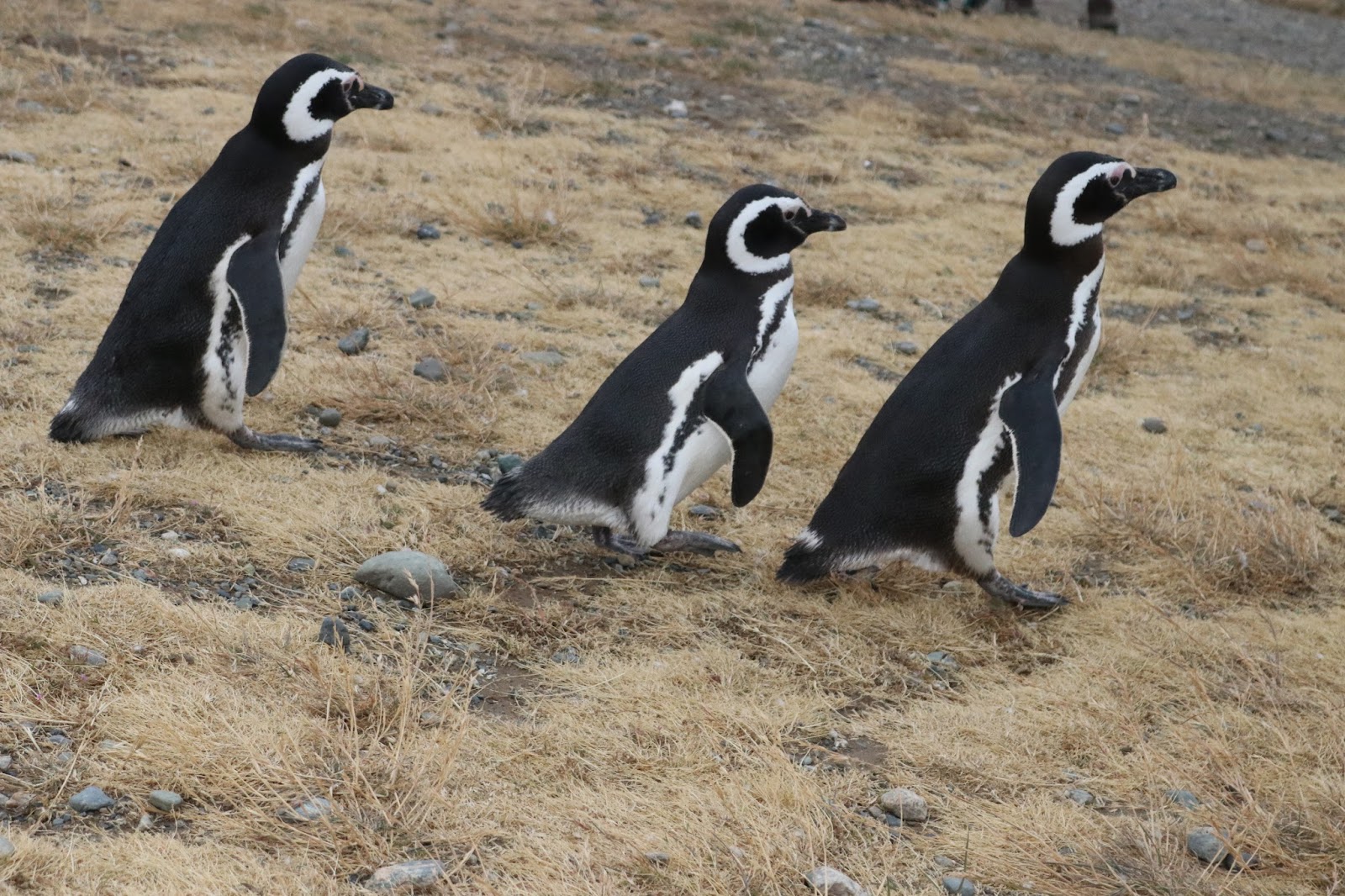
The highlight of our prolonged stay in Punta Arenas was probably a boat trip on Monday 15th January to the tiny Isla Magdalena which is home to a large colony of Magellan penguins. We were marshalled off the boat along with about 200 other people and it felt a little bit like the queue for Kings Cross underground. That said, however, all was redeemed by the quality of what we saw.

 There were approximately 40,000 pairs of breeding penguins, each with their young. The chicks had grown to the same size as their parents by the time we saw them and many of them were losing their fluffy coats and getting into adult plumage. They are very cute and comical when they walk and we much enjoyed seeing them in their little family groups, the chicks being fed by their parents or cuddled up together in their burrows out of the wind. Apparently, the parents take the young down to the sea in February to teach them how to fish and then in March the young set out to sea and leave home for good.


Magellan penguin

Parent and chick relaxing at home

Looking busy and important

Off with the fluffy coats

Anyone got food?

Family group

Cuddled up for a nap

Follow my leader

Down by the shore

Penguins have right of way!

 We want to say a few words about the street dogs in Punta Arenas. The dogs here are not like other dogs we have come across in central and south America. These are large, friendly dogs, well fed for the most part and much inclined to stroll around the place being stroked and patted by the locals who seem to feed them without any compunction. If, for instance, a local is eating a hamburger and there happens to be a dog sauntering past, he will call the dog over and feed it the remains of his hamburger and the dog will courteously accept it, wag his tail politely, then move on.

Very relaxed dog

 You see these dogs lying on the benches in the middle of the plaza in the centre of Punta Arenas and they are the most relaxed animals and one very much gets the impression that they are a completely accepted part of society here.

The boat did come in on Wednesday 17th January, Footloose Lucy was on it, and we were promised that we should have her back on Friday. Alan duly went along to the Port with our local agent and after about four and a half hours of the Customs and Immigration rigmarole, Lucy was delivered back into our tender care.

Lucy being released from her container

The truck was in a bit of a sorry state when she was first released from her container. The tyres had been deflated, the seats were covered in green mould and she wouldn’t start. Not surprising after two months at sea. Our compressor re-inflated the tyres in short order, but the jump leads didn’t do the slightest good. Lucy was then attached to a handy fork lift truck which towed her along for a short distance and Alan was able to bump start the engine.

 Today is Saturday 20th January and we are busying ourselves with sorting out the vehicle and getting provisions. This trip has got off to a slow start, but we hope that tomorrow we shall be on the ferry to Tierra del Fuego.